Why Your Fence Gate Won’t Close After Oklahoma Rain | A/M Fence
- At June 04, 2026
- By greg
- In fence contractor
0
You walk outside the morning after a storm. The yard looks fine. The fence is standing. But the gate is dragging across the concrete, or the latch is missing its catch by half an inch, or you have to lift the whole thing by the frame just to get it shut. Nothing broke. Nothing fell over. But something moved.
That is exactly the point. Your gate is not just being difficult. It is telling you what shifted.
Oklahoma rain does things to a fence gate that dry weather never will. Clay soil swells. Posts rock. Wood expands. Hardware that was set perfectly six months ago is now a quarter-inch out of position, and a quarter inch is enough to turn a smooth-swinging gate into a daily frustration.
This guide covers why it happens, how to read what your gate is telling you, and when the right answer is an adjustment versus a professional repair.
Why Oklahoma Rain Causes Fence Gates to Move
Oklahoma soil is dominated by clay, and clay is not stable when it gets wet.
Dry clay shrinks and pulls away from fence posts. Saturated clay expands outward and pushes against them. After a heavy rain, the soil around your gate posts can shift enough to tilt the post, raise the footing, or push the entire post assembly out of its original alignment. Even a small movement at the base of a post translates into a much larger problem at the top where the gate hangs.
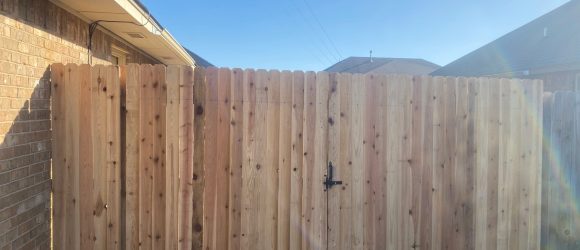
Wood fence gates compound the problem. Cedar, treated pine, and most other fence-grade lumber absorb moisture during rain events. The boards swell across their width. A gate that swings freely with a two-inch clearance in July may have a quarter-inch clearance after a soaking rain in April. That is often the difference between a gate that latches and one that drags.
Metal gates do not swell, but they are not immune. Iron and steel expand slightly with temperature and moisture changes. More importantly, the posts and concrete footings that support a metal gate are still sitting in Oklahoma clay. The hardware is only as stable as the ground underneath it.
The reason gate problems in Oklahoma are so often weather-triggered is not coincidence. The soil, the lumber, and the freeze-thaw cycles that run from October through March create an environment where even a well-built gate needs occasional attention.
The Most Common Reasons a Fence Gate Stops Closing
Not every gate failure has the same cause. Understanding what you are looking at helps you explain the problem accurately and avoid paying to fix the wrong thing.
Hinge failure or loosening. Hinges take the full weight of the gate every time it opens. Screws back out of weathered wood over time. After rain, saturated wood holds fasteners less firmly than dry wood. A hinge that has worked loose by even a small amount causes the gate to drop on the latch side, which is why the gate that used to close smoothly now drags across the concrete or catches the ground before it reaches the latch post.
Latch misalignment. Latches are installed at a fixed height on the gate frame, and the catch or strike is mounted at a fixed point on the post. When the gate drops, sags, or shifts laterally, the latch tongue no longer meets the catch at the right height or angle. The gate appears to close, but the latch does not engage. This is one of the most common complaints after a rain event, and it can be caused by any of the problems on this list.
Post lean. Gate posts carry more stress than line posts because of the constant opening and closing load. In Oklahoma clay, a post can lean inward or outward as soil moisture changes, and a post that leans toward the gate opening narrows the gap that the gate swings into. A post leaning away from the gate increases the gap and lets the gate hang at an angle that puts stress on every hinge screw.
Gate frame racking. A gate frame that was square when it was installed can lose its square shape over time. The diagonal measurement from corner to corner changes as the frame flexes under its own weight and the stress of daily use. A racked frame means the gate no longer hangs plumb, and a gate that is not plumb will not latch reliably regardless of how the hardware is adjusted.
Swollen wood boards. This one is straightforward. Fence boards absorb rain and swell. If a wood gate was built with tight clearances, swollen boards will cause the gate to bind against the latch post or drag on the ground before it reaches the latch point. This often resolves partially as the wood dries out, but repeated wet-dry cycles accelerate the warping and cracking that eventually require board replacement.
Concrete footing movement. Gate posts are typically set in concrete to provide a stable base. But concrete footings can heave when the surrounding clay freezes and expands, or when prolonged saturation allows the footing to shift laterally. A footing that has moved even slightly changes the geometry of the entire gate opening. This is the most significant cause of gate failure because it affects everything above it simultaneously.
Heavy gate racking out of square. Drive-through gates and large custom walk-through gates are heavier than standard residential gate panels. That weight amplifies every small movement in the post or hinge. A heavy gate that is even slightly out of square puts enormous torque on the hinge side post. Over time, this pulls fasteners out of wood, loosens the post-to-concrete connection, and causes the gate frame itself to flex out of square.
How to Tell Whether It Needs Adjustment, Repair, or Replacement
This is where most homeowners spend the most time guessing. The answer comes down to what moved, how far, and how long ago.
Adjustment is usually enough when the post is still plumb and solid, the concrete footing has not moved, the gate frame is still square, and the problem is limited to hinge screws that have backed out slightly or a latch that needs to be repositioned by a small amount. These are real repairs that take skill and the right hardware, but they do not require replacing anything structural.
Repair is the right answer when a post has leaned noticeably out of plumb, a hinge is cracked or bent rather than simply loose, the gate frame has racked out of square, or the latch hardware has been damaged. Repair means correcting the structural problem first, not just adjusting the hardware to compensate for it. Resetting a leaning post, replacing a damaged hinge with one rated for the gate’s weight, or squaring a racked frame before reinstalling hardware are all repair-level jobs.
Replacement is smarter when a wood gate has reached the point where the wood itself is the problem. Boards that are deeply checked, warped, or soft with rot will not hold hinge screws reliably no matter how good the replacement hinges are. A gate post that has cracked at the concrete line, or a footing that has heaved enough to permanently alter the opening geometry, usually needs to be pulled and reset rather than shimmed or adjusted. At some point, the cost of continuing to repair an aging gate exceeds the cost of building a new one that will work correctly for the next decade.
The honest question to ask is this: if we fix the hardware today, is the underlying structure capable of holding that fix for more than one season? If the answer is no, repair spending is compounding rather than solving the problem.
Why Gate Problems Usually Get Worse If Ignored
A gate that drags a little today will drag more next month. That is not pessimism; it is the physics of what happens when a misaligned load is allowed to continue working on already-stressed fasteners and hardware.
Hinge screws that are slightly loose experience more stress every time the gate opens because the gate is now hanging at a slight angle. More stress means faster backing-out. A gate that drops a quarter-inch this month drops three-eighths of an inch by fall.
A latch that does not engage reliably is a security issue. A gate that can be pushed open because the latch is missing is not serving its purpose. For homeowners with dogs, children, or pool enclosures, a gate that will not latch is not a minor inconvenience. It is a liability.
Beyond safety, an unlatched gate swings in Oklahoma wind. A gate panel swinging freely in a storm puts hundreds of pounds of force on two or three hinge screws and the wood they are anchored to. That is how a gate that was inconveniently hard to close becomes a gate that is lying on the ground.
The cost to address a hinge adjustment or a latch realignment is a fraction of the cost to replace a post that has been pulled out of position by six months of a heavy gate swinging against it.
A/M Fence Gate Repair and Custom Gate Options
A/M Fence has been building and repairing gates across Oklahoma City, Edmond, Moore, Norman, and surrounding communities since the beginning. Gates are not an afterthought in this business. They are frequently the most complicated part of any fence project, and they are the part that gets used every single day.
For homeowners dealing with a gate that will not close after rain, the first step is an honest assessment of what actually moved and why. That assessment determines whether adjustment, repair, or replacement is the right path.
For homeowners who are already looking at gate replacement, this is often the right time to build correctly. A gate that is sized appropriately for its opening, hung on hinges rated for its weight, and supported by posts set deep in concrete footings will not drag or sag after the first seasonal rain. That is not a complicated formula. It just requires building it right the first time.
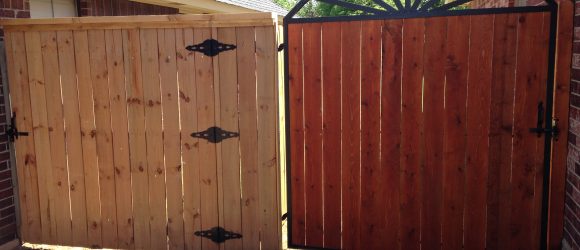
A/M Fence builds and installs custom gates in Oklahoma City ranging from standard walk-through panels to large drive-through gates with automated operators. If you are looking at upgrading from a failing wood gate to a more durable solution, iron gate installation is worth discussing. Iron gates do not swell with moisture, do not warp through wet-dry cycles, and are built to support their own weight without depending on wood screws in weathered lumber.
If you are keeping your existing fence and just need the gate addressed, understanding what causes sag in the first place helps you make a better decision about what to fix. The gate sag prevention guide on this site covers the installation-side factors that determine whether a gate holds up over time.
For homeowners replacing the fence entirely, wood fence options include material and construction choices that affect how the fence and gate system will perform through Oklahoma’s seasonal moisture swings.
Call A/M Fence at (405) 476-5391 to schedule a free estimate. We serve Oklahoma City, Edmond, Moore, Norman, Yukon, Mustang, and surrounding metro communities.
Frequently Asked Questions
Can a sagging fence gate be fixed without replacing it?
Often, yes. Whether a sagging gate can be fixed depends on what caused the sag. Loose hinge screws, a latch that has dropped out of alignment, or a gate frame that has racked slightly are all repairable without replacing the entire gate. However, if the post has leaned significantly, the concrete footing has moved, or the gate frame wood has deteriorated to the point where it cannot hold fasteners reliably, repair spending on hardware will not solve the underlying problem. A professional assessment tells you which situation you are dealing with before money is spent.
Why does my gate close fine when dry but not after rain?
The two most common causes are wood swelling and post movement. Wood fence gates absorb moisture and expand slightly during rain events. If the gate was built with minimal clearance on the latch side, that expansion is enough to cause binding. Post movement is the other common cause. Oklahoma clay expands when saturated, which can shift a gate post enough to change the geometry of the opening. Both problems confirm that the gate is working correctly relative to its environment but that the environment is exposing a clearance or installation issue that needs to be addressed.
Should I repair or replace a wooden fence gate?
Repair makes sense when the frame and post are structurally sound and the issue is hardware. Replacement makes more sense when the wood itself is the problem. Soft spots, deep checking, warped boards, or rot at the post base are signs that the gate has reached the end of its serviceable life. Replacing the gate while leaving a compromised post in place is a short-term fix. The right approach is to assess the post at the same time.
Do you install custom gates in OKC, Moore, Norman, and Edmond?
Yes. A/M Fence installs custom walk-through and drive-through gates across the OKC metro including Oklahoma City, Edmond, Moore, Norman, Yukon, and Mustang. Gate options range from standard wood panels to ornamental iron gates and automated drive-through systems. Call (405) 476-5391 or contact A/M Fence online to schedule a free estimate.
How long does it take for a gate to return to normal after rain?
A wood gate that has swollen due to rain will typically return closer to its dry dimensions within a few days of dry weather, depending on temperature and humidity. However, if the gate was already marginal in terms of clearance, each wet-dry cycle causes additional wood movement that compounds over time. A gate that closes fine after it dries out but fails every time it rains is telling you that the clearance is too tight and will only get worse.
A/M Fence serves Oklahoma City, Edmond, Moore, Norman, Yukon, Mustang, and surrounding metro communities. Call (405) 476-5391 for a free estimate.
Does Oklahoma City Law Require a Fence Around Your Pool? Here’s What Homeowners Need to Know
- At May 19, 2026
- By greg
- In General Fence Building
0
You just had a pool installed, or maybe you’re still in the planning stages. Either way, a backyard pool is a serious upgrade, and it makes sense that your mind is on the fun parts: the water, the landscaping, maybe a new patio set. A fence probably isn’t the first thing you’re thinking about.
But if you own a pool in the Oklahoma City area, a fence isn’t optional. It’s the law.
Pool Fencing Is Required in Oklahoma City and Most Surrounding Cities
Oklahoma City municipal code requires residential swimming pools to be enclosed by a fence or barrier. This isn’t unique to OKC. The vast majority of cities in the greater metro area have similar ordinances on the books, most of them modeled on international residential building code standards. If you’ve got a pool, you’re expected to have a compliant barrier around it, full stop.
This applies to in-ground pools, above-ground pools that meet a certain depth threshold, and in many cases hot tubs and spas as well. If you’re not sure whether your specific setup triggers the requirement, the safest assumption is that it does.
What the Law Generally Requires
While specific rules vary by city (more on that in a moment), most pool fence ordinances in the OKC metro share a common baseline. Here’s what you’ll typically see required:
- Minimum height of 48 inches. Your fence needs to be at least four feet tall. Some cities require more, but four feet is the floor for most jurisdictions in this area.
- Self-latching and self-closing gates. Any gate in the fence has to close and latch on its own. You can’t rely on someone remembering to pull it shut. The latch should also be positioned so that a small child can’t easily reach it, typically on the pool side of the gate and at a height above 54 inches.
- No gaps larger than 4 inches. This keeps small children from squeezing through openings or getting a foothold to climb. Horizontal rails, decorative cutouts, and wide-spaced pickets can all create gaps that put you out of compliance.
- Non-climbable design. A fence that’s easy to scale doesn’t provide much protection. Chain-link, for example, is often prohibited for pool enclosures because it’s essentially a ladder. Many cities require vertical picket-style fencing or other designs that don’t give kids a foothold.
Requirements Vary By City, So Check With Yours
The points above cover the general standard, but the details can differ depending on where you live. If your home is in Edmond, Moore, Norman, Midwest City, Yukon, or Guthrie, your city may have its own specific language around pool barriers, permit requirements, or inspection processes.
Before you install anything, contact your local municipal building department and ask what’s required for a residential pool enclosure. It’s a quick call and it saves you from having to redo work later. Most cities also post their codes online if you’d rather start there.
What Happens If Your Fence Isn’t Compliant
Beyond the building code side of things, a non-compliant pool fence creates real exposure for you as a homeowner. If someone is injured in or around your pool and your barrier doesn’t meet local code, you could be held liable even if the person wasn’t supposed to be on your property.
Oklahoma follows what’s known as the attractive nuisance doctrine, which holds that homeowners can be responsible for injuries to children who wander onto their property and are drawn to something dangerous, like a pool. A non-compliant or missing fence is a significant factor in how that liability plays out.
On top of that, your homeowner’s insurance policy may not cover incidents related to a pool if you’re out of compliance with local ordinances. Some insurers require proof of a compliant enclosure as a condition of coverage. It’s worth calling your agent before installation to understand exactly where you stand.
How A/M Fence Can Help
A/M Fence has been installing fences across the Oklahoma City metro for years, including Norman and the surrounding communities. We’re familiar with local pool fence requirements and install enclosures that meet code standards for height, gate hardware, and design.
If you want a fence that does its job and holds up to Oklahoma weather, we’re glad to come out, take a look at your yard, and give you an honest quote. No pressure, no sales pitch, just a straight conversation about what you need.
Contact A/M Fence today for a free quote on pool fence installation by calling (405) 476-5391. You can reach us through our website or by phone, and we serve homeowners throughout the greater OKC metro area.
Should You Repair or Replace a Chain Link Fence?
- At April 14, 2026
- By greg
- In General Fence Building
0
If your chain link fence is leaning, damaged, or not working like it should, you may be wondering whether it makes more sense to repair it or replace it. In some cases, a simple repair is enough. In other cases, replacement is the smarter long-term choice. A/M Fence is based in Norman, OK and helps property owners across Norman, Oklahoma City, and surrounding areas with chain link fence repair and installation. If you want a clear answer for your property, call (405) 476-5391 for a free estimate.
When a Chain Link Fence Can Often Be Repaired
Not every damaged fence needs to be torn out. Many chain link fences can be repaired if the problem is limited and the rest of the fence is still in good shape.
A repair may make sense if:
- only one section is bent or broken
- one or two posts are loose, but most of the fence is stable
- a gate is sagging or not latching right
- storm damage affected one area instead of the whole fence
- a few parts are worn, but the fence still has good structure overall
In cases like these, a repair can help extend the life of the fence without the cost of full replacement.
Signs Your Chain Link Fence May Be Repairable
Damage Is Limited to One Area
If the damage is only in one spot, repair is often the better choice. For example, maybe a section was hit by equipment, a post shifted, or a gate got bent. If the rest of the fence is still standing strong, targeted work may solve the problem.
Most Posts Are Still Solid
Fence posts matter. If most of the posts are still firm and straight, there is a better chance the fence can be repaired instead of replaced.
The Fence Is Still Doing Its Job
If the fence still provides security, keeps pets in, or marks the property line well, a repair may be enough to bring it back into good working shape.
The Fence Is Not Too Old
An older fence can still be repairable, but age matters. If the fence is not badly worn all over, it may still have useful life left after repairs.
When It May Be Time to Replace the Fence
Sometimes repairs turn into a patchwork fix that keeps costing money. If the fence has widespread damage or ongoing problems, replacement may be the better investment.
A full replacement may make more sense if:
- multiple sections are bent, rusted, or failing
- several posts are leaning or loose
- the fence has already been repaired many times
- rust or corrosion is showing up in many places
- the fence no longer provides real safety or security
- gates, rails, fabric, and posts are all wearing out together
If the main parts of the fence are breaking down at the same time, replacing the fence may save money over time.
Signs It May Be Time to Replace the Fence
Rust or Corrosion Is Widespread
A little surface wear may not be a big issue, but large areas of rust can weaken the fence. When corrosion affects many parts of the fence, repairs may only delay a larger problem.
Several Posts Are Leaning
If one post is loose, that may be repairable. If many posts are leaning or shifting, the fence may no longer have the support it needs. At that point, replacement may be the more reliable option.
The Fence Has Been Repaired Again and Again
A repair here and there is normal. But if the same fence keeps needing work, the costs can add up. Replacing it may be more practical than paying for repeat repairs.
The Fence No Longer Looks or Functions Well
A chain link fence should still do its job. If it no longer looks presentable, does not close properly, or cannot provide the level of security you need, replacement may be the better path.
Repair vs. Replacement: What Makes the Most Sense?
The biggest question is not just, “Can this fence be repaired?” The better question is, “Is repairing it worth it?”
A repair usually makes sense when the damage is limited and the rest of the fence is still in solid shape. Replacement makes more sense when the fence has widespread wear, repeated problems, or structural issues that are likely to keep getting worse.
For example, a bent section after a storm may be a simple repair. A fence with rust, loose posts, worn gates, and multiple damaged sections is a different story. In that case, replacing the fence may give you better value and fewer headaches.
The smartest move is to have the fence looked at by someone who can give you an honest recommendation based on its actual condition.
Oklahoma Weather Can Be Hard on Fences
Property owners in Norman, Oklahoma City, and nearby areas know that weather can be rough on outdoor structures. Strong wind, storms, and long-term exposure can wear down chain link fencing over time. That does not always mean replacement is needed, but it does mean small issues should not be ignored for too long.
A loose post, damaged gate, or bent section may seem minor at first, but those problems can get worse if left alone.
Chain Link Fence Repair and Replacement for Homes and Businesses
Chain link fence is used for many types of properties. Some people need it for backyard security or pet containment. Others need it for commercial property, storage areas, or general boundary marking.
Whether the fence is residential or commercial, the same basic rule applies: if the structure is still sound, repair may be the right move. If the fence is worn out across the board, replacement may be the better long-term answer.
Serving Norman, Oklahoma City, and Surrounding Areas
A/M Fence is based in Norman, OK and serves customers throughout the area, including Oklahoma City, Edmond, Moore, Midwest City, Yukon, Guthrie, and nearby communities. If your chain link fence has damage and you are not sure what to do next, we can help you understand your options.
Chain Link Fence FAQ’s
How do I know if my chain link fence can be repaired?
If the damage is limited to one section, one gate, or a small number of posts, repair may be enough. A fence with widespread rust, leaning posts, or repeated damage may be a better candidate for replacement.
Is it cheaper to repair a chain link fence or replace it?
Repair is usually cheaper in the short term when the damage is minor. If the fence has problems in several areas, replacement may save more money over time.
Can a leaning chain link fence be repaired?
Sometimes, yes. If only one or two posts are leaning, repair may be possible. If the fence is leaning in several areas, replacement may be the better option.
When should a chain link fence be replaced instead of repaired?
Replacement may make more sense when the fence has widespread rust, multiple weak posts, major storm damage, or a long history of repairs.
Does rust mean a chain link fence has to be replaced?
Not always. Small areas of wear do not always mean full replacement. If rust is spread across many sections and has weakened the fence, replacement may be the smarter choice.
Can you repair a chain link fence gate?
Yes, in many cases gates can be repaired if the problem is limited to the latch, hinges, frame, or alignment. If the gate and surrounding fence are both badly worn, replacement may be worth considering.
Get a Free Estimate
If you are trying to decide whether to repair or replace a chain link fence, A/M Fence can help. We provide chain link fence repair and chain link fence installation for property owners in Norman, Oklahoma City, and surrounding areas.
Call (405) 476-5391 today for a free estimate and honest guidance on the best option for your fence.
How Oklahoma Homeowners Hide Trash Bins With Fencing
- At March 16, 2026
- By greg
- In General Fence Building
0
Trash bins are necessary, but they rarely improve the look of a yard. In many Oklahoma neighborhoods, homeowners are now using fencing to hide garbage and recycling containers while keeping their outdoor spaces clean and organized.
A properly designed trash bin enclosure blends into your landscape, protects containers from Oklahoma wind, and keeps animals from getting into your garbage. With the right materials and layout, it can look like a natural extension of your fence rather than an afterthought.
At A/M Fence, we regularly help homeowners design practical fencing solutions that hide trash bins while maintaining easy access for weekly pickup.
Why Oklahoma Homeowners Hide Trash Bins
Across Oklahoma City, Edmond, Moore, and surrounding communities, trash containers are often required to stay outside. Unfortunately, they can quickly become an eyesore.
Fencing provides several benefits:
Improves curb appeal
Trash bins placed beside the house or driveway can stand out visually. A small enclosure built with matching fence materials helps keep your yard looking organized.
Prevents wind problems
Oklahoma wind can easily knock over trash containers. A fenced enclosure helps keep bins upright and contained during storms.
Keeps animals out
Raccoons, stray cats, and even neighborhood dogs are known for getting into trash. A properly designed enclosure makes it much harder for animals to access your garbage.
Maintains HOA compliance
Many homeowner associations require trash bins to be hidden from street view. A small fence enclosure can help meet those requirements without moving containers far from the house.
Fence Designs That Work Best for Trash Bin Enclosures
Not every fence style works well for hiding trash containers. The key is balancing visibility, airflow, and access.
Cedar Privacy Fence Enclosures
Cedar fencing is one of the most popular solutions in Oklahoma neighborhoods.
Advantages include:
-
Strong visual coverage
-
Matches most residential fences
-
Durable in Oklahoma weather
-
Can be stained or sealed to match existing fencing
A three-sided cedar enclosure with a gate is a common setup that hides bins while keeping them easy to roll out on trash day.
Horizontal Fence Panels
Modern homes often prefer horizontal fencing for trash enclosures.
This design:
-
Looks clean and contemporary
-
Allows airflow between boards
-
Blends well with landscaping
Horizontal panels can be built using cedar or treated wood depending on the look you want.
Chain Link With Privacy Slats
For some homeowners, cost and durability are the main concerns.
Chain link with privacy slats provides:
-
Lower installation cost
-
Long lifespan
-
Good airflow for trash odors
-
Solid visual coverage when slats are installed
This option is often used behind homes or near alley access areas.
Where Trash Bin Enclosures Work Best
Placement matters when designing an enclosure.
Some of the most common locations include:
Beside the garage
Many Oklahoma homes store trash bins along the side of the garage. A short fence extension can easily hide containers while keeping them near the driveway.
Behind the house
For homeowners with larger yards, placing bins behind the house keeps them completely out of sight.
Near alley access
In parts of Oklahoma City where trash pickup happens in alleyways, small fenced enclosures help keep bins contained while still accessible to sanitation crews.
Important Design Tips for Trash Bin Fencing
A well-built enclosure should make life easier, not harder.
Here are a few things homeowners should consider before installing one.
Leave space for multiple bins
Many households now have trash, recycling, and yard waste containers. Make sure the enclosure is wide enough to hold them all comfortably.
Install a simple gate
A gate makes it easy to roll containers out on pickup day. Without one, lifting bins over the fence becomes frustrating quickly.
Use durable materials
Trash areas see heavy use. Strong posts and weather-resistant materials will help your enclosure last longer.
Match your existing fence
The best trash enclosures look like they were built as part of the original fence, not added later.
Why Professional Fence Installation Matters
Small projects like trash enclosures still need proper construction.
Posts must be set securely in Oklahoma soil, gates should swing correctly, and materials must handle strong wind and seasonal weather changes.
A professionally installed enclosure will last longer, look better, and integrate smoothly with your existing fence.
When a Backyard Trash Enclosure Becomes a Dumpster Enclosure
For most Oklahoma homeowners, a small fenced area for trash and recycling bins is enough to keep the yard looking clean and organized. These enclosures are often built beside the garage, along a backyard fence line, or near alley pickup areas for easy access on pickup day.
However, the same concept scales up for larger properties.
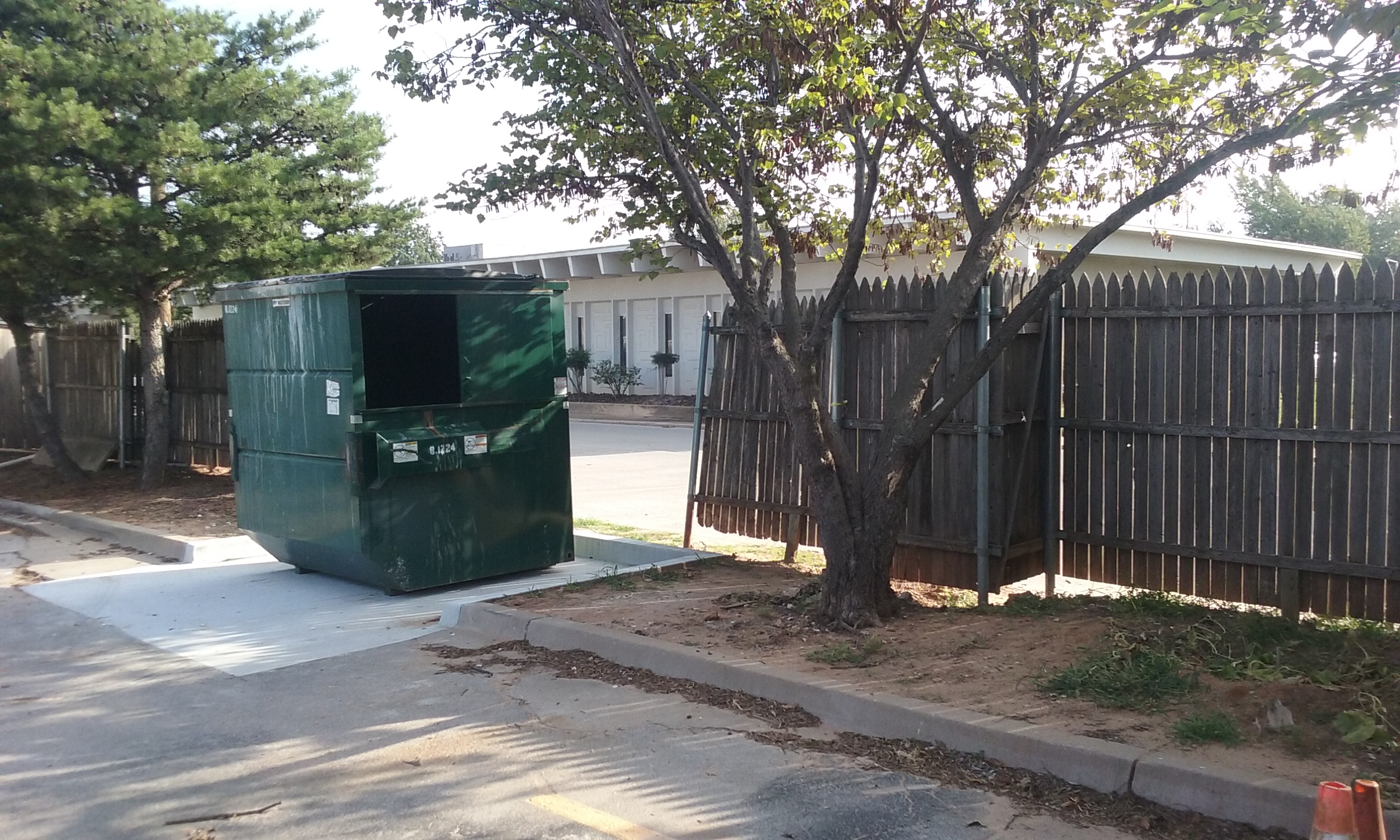
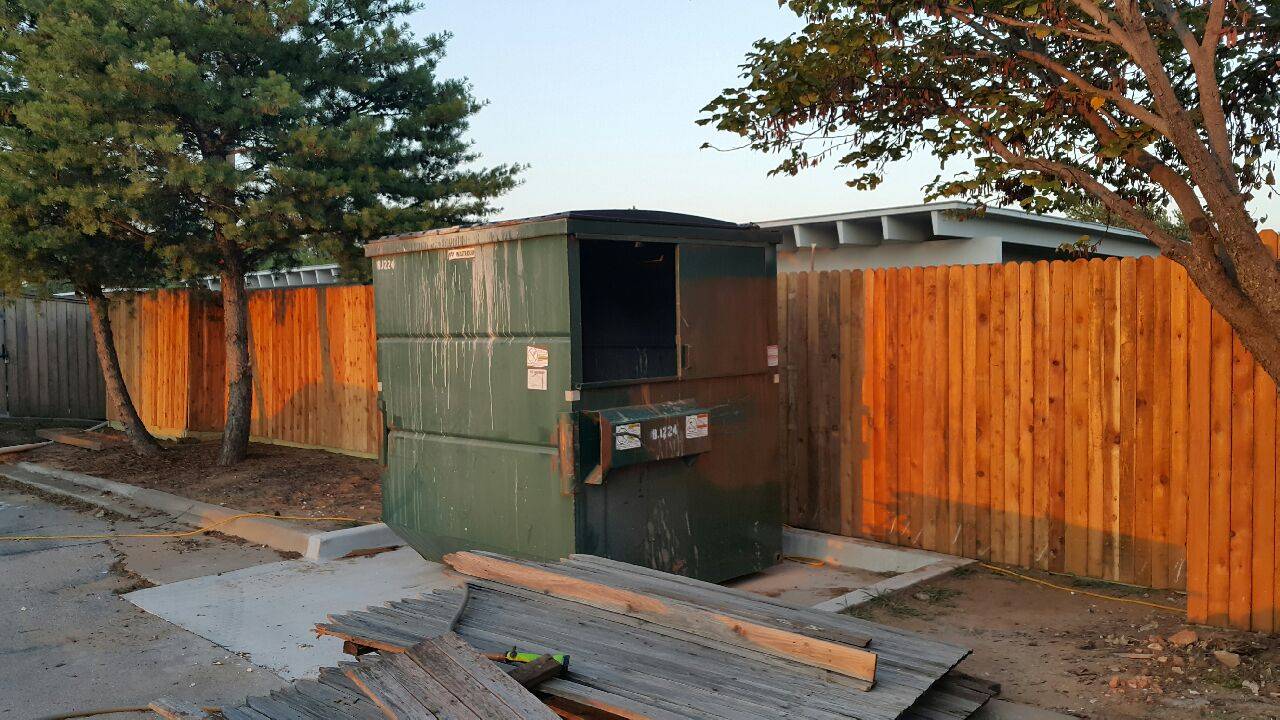
Across Oklahoma City, Edmond, Moore, and surrounding communities, apartment complexes, restaurants, retail centers, and HOA-managed neighborhoods often install larger dumpster enclosure fences that follow the same basic design principles as residential trash bin enclosures. The difference is simply size, durability, and the need to meet local guidelines.
These larger enclosures help maintain a clean appearance, control access to trash areas, and keep waste contained in Oklahoma’s wind-prone conditions.
A properly built enclosure helps:
-
hide dumpsters from public view
-
prevent illegal dumping
-
keep wind from blowing trash across parking areas
-
meet HOA or city appearance guidelines
Many of the dumpster enclosures we install use wood privacy fencing or chain link with privacy slats, depending on the property layout and maintenance needs.
If you’re planning a larger enclosure project, you can learn more about our dumpster enclosure fence installations in Oklahoma City.
FAQ: Trash Bin Fence Enclosures
How big should a trash bin enclosure be?
Most residential enclosures are built around 6–8 feet wide, which allows space for two or three bins and easy movement when rolling containers out.
Do trash bin enclosures require permits in Oklahoma?
Most small residential enclosures do not require permits, but HOA rules may apply depending on the neighborhood.
What fence material lasts longest for trash enclosures?
Cedar and metal fencing tend to last longest in Oklahoma weather, especially when properly installed with concrete-set posts.
Can trash enclosures match my existing fence?
Yes. In most cases, enclosures can be built using the same materials and style so they blend naturally into the fence line.
Hide Trash Bins Without Compromising Your Yard
A small fence enclosure can make a big difference in how your yard looks and functions. Whether you want to hide trash containers beside the house or need a larger dumpster enclosure for a property, the right design keeps your space clean and organized.
A/M Fence works with homeowners across Oklahoma City and surrounding areas to build practical fencing solutions that fit each property.
If you are considering a trash bin enclosure or fence installation project, our team can help you design something that looks great and lasts for years.
Request a quote today
or call
(405) 476-5391
Best Fence Materials for Norman Weather (From a Guy Who’s Fixed a Lot of Bad Fences)
- At February 13, 2026
- By greg
- In General Fence Building
0
If you live in Norman, you already know our weather does not play nice.
Wind that’ll push a trash can into your neighbor’s yard.
Sun that cooks paint right off wood.
Rain that turns clay soil into soup.
Then winter shows up and cracks everything that was already tired.
Worried your fence won’t survive the next wind or hail storm?
Call (405) 476-4391 and I’ll come look at your yard in person. I’ll tell you straight what can be fixed, what can’t, and what actually makes sense for your place.
No pressure. No sales games. Just real advice from someone who’s fixed a lot of bad fences in Norman.
I’ve been putting up and fixing fences in Norman for about 20 years.
I’ve worked in Westwood, Rollingwood, Summit Lakes, Belmar Hills, and just about every street between Main and Tecumseh.
I’ve seen what lasts.
I’ve seen what fails.
And I’ve fixed a whole lot of stuff that never should’ve been built the way it was.
If you’re trying to decide what kind of fence to put in, I’ll tell you straight what works here and what doesn’t.
The Stuff That Actually Wrecks Fences in Norman
Most fences don’t fail because the boards were “bad.” They fail because the ground moves and the wind doesn’t care.
In Norman, you’re dealing with four real stressors:
- Clay soil that swells when it gets wet and shrinks when it dries
- Spring winds that hit open neighborhoods like Rollingwood and Southwind Pointe
- Sun that bakes paint and dries out wood
- Freeze-thaw cycles that crack shallow footings
If posts aren’t set right or the material is wrong for the yard, fences start leaning fast.
What Fence Materials Actually Hold Up Here
Vinyl
If you want low maintenance and fewer headaches, vinyl is hard to beat.
It doesn’t rot.
It doesn’t attract bugs.
It doesn’t need staining every year.
I’ve gone back to vinyl fences in Summit Lakes and Belmar Hills that are still standing straight after years of wind and storms. Homeowners barely have to touch them. Hose them off once in a while and they’re good.
The tradeoff is simple. Vinyl costs more up front. But over time, most folks save money because they’re not fixing boards every couple of years.
Wood
Wood looks great. I won’t pretend it doesn’t. But wood is work.
If you don’t seal it.
If you don’t stain it.
If you ignore it for a few years.
It starts to warp.
Then rot.
Then you’re calling someone like me to fix it.
I’ve rebuilt a lot of wood fences in Westwood and Rollingwood that were only six or seven years old because nobody told the homeowner how much upkeep wood really needs.
If you love the look and you’re willing to take care of it, wood can be a good fence. If you want “set it and forget it,” wood is not your friend.
Chain Link
Chain link isn’t pretty. But it works.
It holds up to wind.
It doesn’t care about sun.
Dogs don’t knock it over.
I put a lot of chain link on bigger lots near Goldsby and south of Norman. It’s good for pets and boundaries. It’s not going to fall over unless the posts were done wrong.
Aluminum / Ornamental
This is what people pick for front yards and pools.
It looks clean.
It doesn’t rust.
It holds up to weather well.
It won’t give you privacy. But if you want curb appeal and something that won’t rot out, aluminum does fine in Norman.
The Part Most People Get Burned On (Post Depth)
Material matters. But posts matter more.
Here’s what actually keeps fences standing in Norman:
- Posts set deep enough to stay put when clay soil shifts
- Gravel under concrete so water drains instead of sitting
- Bracing based on how much wind the yard takes
A couple years back, I got a call in Rollingwood after a bad freeze and heavy rain. Fence was leaning bad. Posts wobbling. The homeowner was frustrated because the fence was “new.”
We pulled one post. It was barely 18 inches deep. No gravel. Just concrete sitting in wet clay.
We reset the posts the right way.
That fence hasn’t moved since.
That wasn’t a material problem.
That was a shortcut problem.
Straight Answers to Common Questions
- Do I need a permit?
Sometimes, depending on height and where the fence sits. I’ll tell you what you need. - How long does install take?
Most jobs are one to three days if the weather cooperates. - Can you fix a leaning fence or does it all need replaced?
Sometimes it can be saved. Sometimes it can’t. I’ll be honest with you. - What areas do you work in?
Norman, Moore, Noble, Goldsby, south OKC.
If You’re On the Fence (No Pun Intended)
If your fence is leaning.
If boards are popping.
If hail or wind just tore something up.
Or if you’re planning a new one and don’t want to regret it later.
You don’t need a sales pitch.
You need someone to walk your yard and tell you what actually makes sense for your property.
Call (405) 476-4391.
I’ll come take a look.
No pressure.
No games.
Just straight answers so you can decide what’s right for your place.